
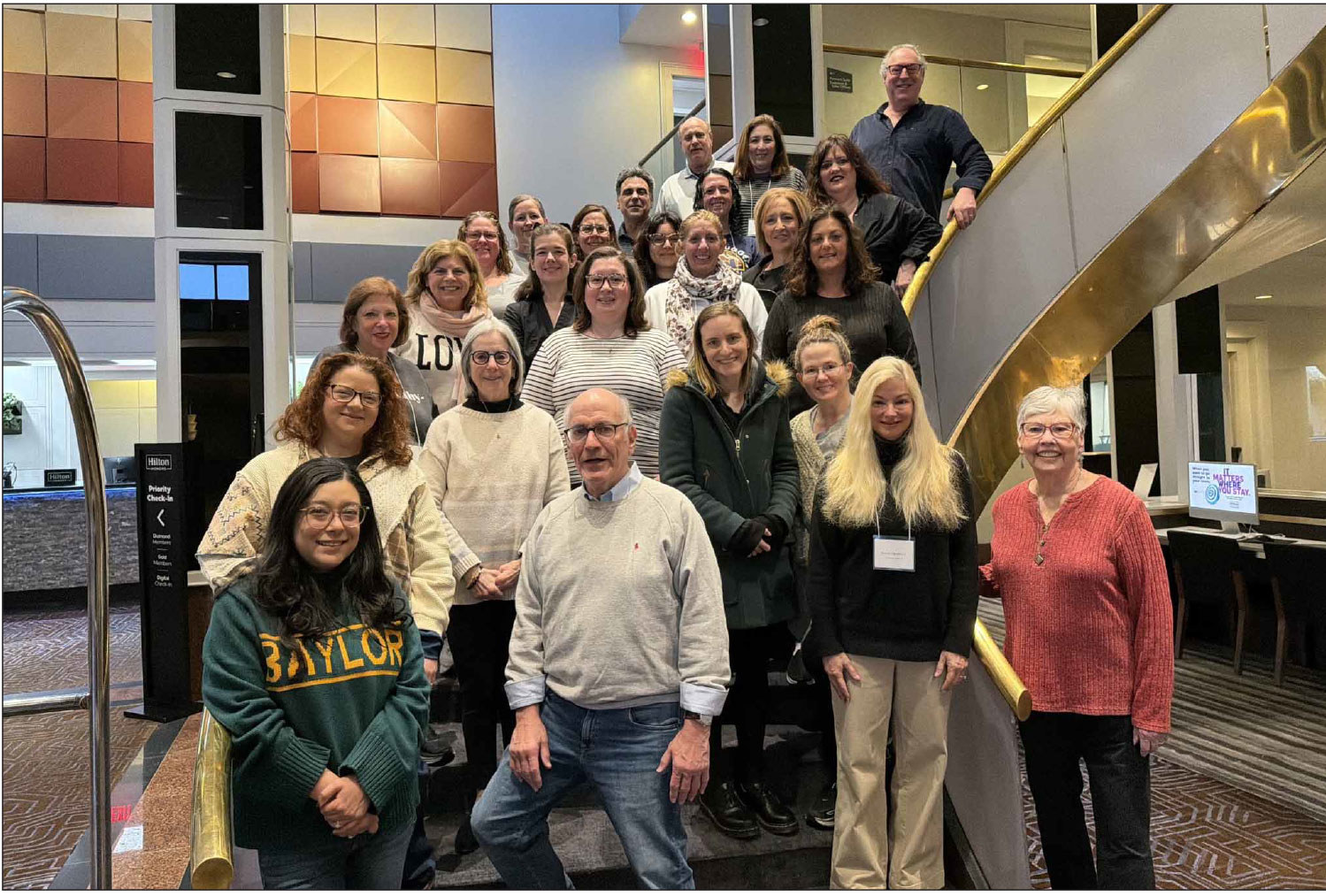
Lauren Crampton, Education director of HERC, attended the 2026 Jewish Foundation for the Righteous Advanced Seminar on Holocaust education. This year, JFR selected 23 middle and high school educators and Holocaust center staff from eight states to participate in its 2026 Advanced Seminar, which took place January 17-18 in New Jersey. The seminar is an intensive two-day, graduate-level program focused on strengthening Holocaust education and addressing both historical and contemporary antisemitism. The program is open to JFR Alfred Lerner Fellows and to middle and high school educators who already have attended the JFR Summer Institute for Teachers. The program is open to JFR Alfred Lerner Fellows and to middle and high school educators who already have attended the JFR Summer Institute for Teachers. Both programs are meant for educators who teach the Holocaust either in classrooms or through Holocaust centers, have taught for at least five years, and are at least five years from retirement.
The 2026 seminar focused on the future of teaching the Holocaust. Sessions explored how artificial intelligence may influence historical research, survivor testimony, classroom instruction, and the spread or mitigation of antisemitism. Organizers said the goal was to ensure educators are equipped to navigate new technologies responsibly while maintaining academic rigor and historical accuracy. Each year, fewer Holocaust survivors remain to share their stories. Educators have grappled with questions about how teaching the Holocaust will change when survivors are gone and in a world of fast-changing media, including the infusion of artificial intelligence. Advances in technology create some risks but also hold opportunities, such as hologram projections of Holocaust survivors that are able to interact with the public and respond to questions.
Participants in the seminar are already well versed in Holocaust history and are given the opportunity to study more focused topics relating to the Holocaust and antisemitism. Special emphasis was placed this year on the opportunities and challenges of artificial intelligence in Holocaust education and research. One of the sessions, she said, focused on how to get students engaged and see Holocaust education as relevant. Another centered on how to avoid misinformation about the Holocaust coming from AI.
Stanlee Stahl, the executive vice president of the Jewish Foundation for the Righteous explained that “teachers have a responsibility to ensure that what they are teaching is factual … or not. Because if it’s not, that can lead Holocaust distortion. Teachers who have so much on their plate as it is, (they have to have) an understanding when you present information to your students, you have to make sure it is factual.”
Speakers at this year’s seminar included Andy Pearce of University College London, Avinoam Patt of New York University, Noah Shenker of Colgate University and Holocaust historian and exhibition curator Paul Salmons. Each addressed different dimensions of Holocaust scholarship, memory, and education, with particular attention to contemporary challenges facing teachers. Other participants traveled from Alabama, Arkansas, Florida, Illinois, New Jersey, Pennsylvania and South Carolina.
“Each of these educators has already distinguished themselves through a strong commitment to teaching the Holocaust and to deepening their own understanding of the antisemitism that shaped it,” said Stanlee Stahl. “Through this intensive, graduate-level program, participants developed a more nuanced understanding of Holocaust history, testimony, pedagogy and contemporary tools and challenges for teaching about the Holocaust, strengthening their own effectiveness in the classroom and enabling them to mentor other colleagues who teach the subject.”